What happens when you take a catalog designed to make us want more and turn it into something beautiful using only what you already have?
Remember When Christmas Started With a Toy Catalog?
There was a time when Christmas didn’t begin with online shopping, endless advertisements on our phones, or packages arriving at the front door almost every day.
It began with a catalog.
If you’re of a certain age, you probably remember exactly what I’m talking about.
The Sears Wish Book. The JCPenney Christmas Catalog. Those wonderfully thick books filled with everything a child could possibly imagine wanting for Christmas.
I can remember the excitement of looking through page after page of toys, games, dolls, bicycles, and things I didn’t even know existed until I saw them in those catalogs.
There was something magical about it.
You didn’t simply glance through the pages.
You studied them.
You circled the things you wanted. You folded down corners. You made lists. You went back and looked at your favorite pages over and over again.
And sometimes, just imagining what might be waiting under the Christmas tree was almost as exciting as Christmas morning itself.
Those catalogs were more than advertisements.
They were part of the Christmas experience.
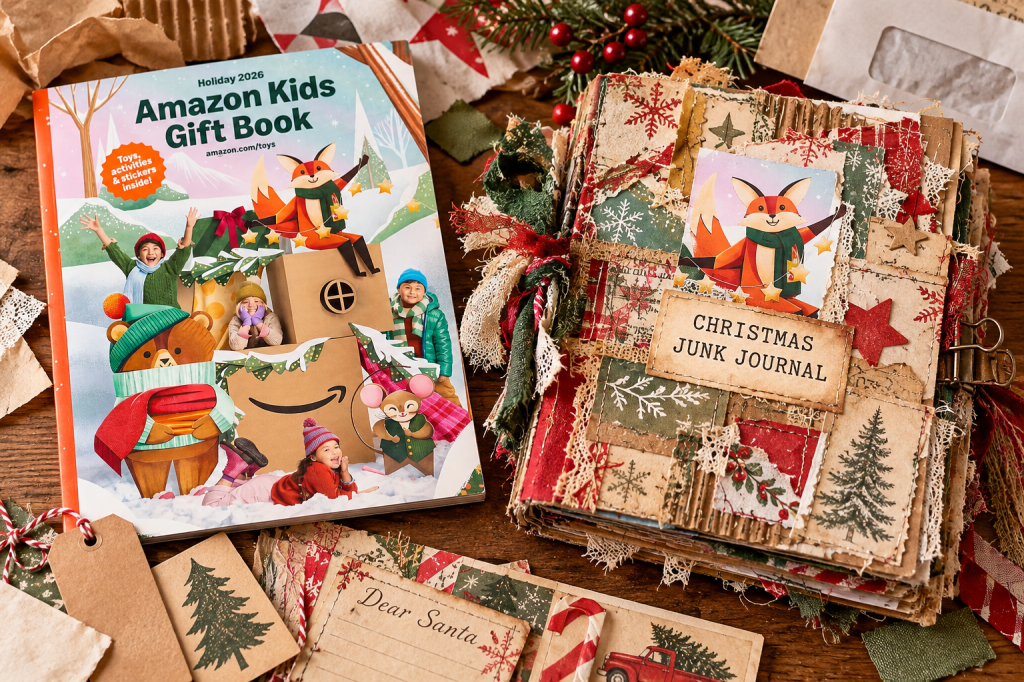
And perhaps that’s why, when I looked at an Amazon Kids Christmas Toy Catalog, I saw something a little different.
I didn’t just see a book filled with toys.
I saw an opportunity to bring a little of that old-fashioned Christmas magic into something handmade.
And I thought, why not turn it into a junk journal?
But not just any junk journal.
I wanted to make one using things most people throw away and whatever supplies I already had.
No shopping trip. No new Christmas paper collection. No expensive embellishments.
Just a toy catalog, some discarded materials, and a little imagination.
A Catalog That Wants Us to Buy More — And a Project That Doesn’t Require Buying Anything
There’s something rather amusing about the whole idea when you think about it.
The Amazon Kids Christmas Catalog exists for one reason: to show us things we might want to purchase.
Page after page of colorful toys, exciting games, and the newest things children are hoping to find under the Christmas tree.
And here I am, taking that very catalog and turning it into something without buying a single new thing.
I love the irony.
Especially at Christmas, when everything around us seems to encourage spending.
We see beautiful decorations, perfectly wrapped presents, elaborate holiday displays, and endless ideas for things we supposedly need to make the season special.
Even in the crafting world, it’s easy to get caught up in buying.
A new Christmas paper collection. Another package of vintage-looking stickers. Special ribbons. Decorative tags. Coordinating embellishments.
And before you know it, you’ve spent quite a bit of money preparing to make something that was originally supposed to be created from scraps.
Now, don’t misunderstand me.
I love beautiful craft supplies.
But I also love the challenge of making something interesting from materials that weren’t necessarily intended to be beautiful.
And that’s what I wanted this journal to celebrate.
The Things We Throw Away Without Thinking
Once I started considering what I could use for this project, I realized just how much potentially interesting material passes through our hands every day.
Think about it.
The envelopes that arrive in the mail.
The brown paper stuffed inside shipping boxes.
The cardboard packaging from groceries.
Receipts, shopping lists, paper bags, advertising flyers, and little scraps of wrapping paper.
We handle these things, use them for a few moments, and throw them away.
We rarely stop to consider their colors, textures, patterns, or shapes.
But when you begin looking at them through the eyes of a junk journaler, something changes.
An envelope isn’t just an envelope anymore.
It’s a pocket waiting to happen.
A piece of cardboard isn’t simply packaging.
It’s a sturdy tag, a journal card, or perhaps part of a cover.
That wrinkled brown paper from a shipping box?
It has a texture that people sometimes spend money trying to recreate.
And the little bits of Christmas wrapping paper left over from wrapping gifts?
Those can become some of the prettiest details in a handmade journal.
I think that’s one of the things I enjoy most about junk journaling.
It encourages us to look twice at things we normally overlook.
I Didn’t Want to Erase the Catalog’s History
One thing I knew from the beginning was that I didn’t want to completely disguise the Amazon catalog.
After all, what would be the point of using a Christmas toy catalog if nobody could tell what it used to be?
I wanted pieces of its original identity to remain.
A bit of colorful advertising showing through a layer of torn paper.
Part of a toy illustration peeking out from behind a pocket.
Perhaps a recognizable section of the cover incorporated into the finished journal.
Those little details would tell the story of where the journal began.
And I think that’s important.
Sometimes, when we’re making junk journals, we become so focused on covering everything with beautiful papers and embellishments that we lose the character of the original materials.
But I didn’t want this journal to pretend it was something else.
I wanted it to be exactly what it was.
A modern Christmas toy catalog transformed into a handmade book.
A little messy in places.
Unexpected in others.
And filled with the kind of character that comes from using real discarded materials rather than perfectly coordinated decorative papers.
Mixing Yesterday’s Christmas With Today’s
One of the things I find particularly interesting about this project is the contrast between old-fashioned Christmas memories and modern Christmas advertising.
The catalogs I remember from years ago had their own distinctive look.
The photography, the typography, the toys, even the way the pages were arranged all reflected a particular time.
Today’s toy catalogs are different.
They’re brighter, more contemporary, and filled with products that would have seemed unimaginable when I was a child.
But the excitement they represent hasn’t really changed.
Children still dream about Christmas morning.
They still make wish lists.
They still imagine what might be wrapped beneath the tree.
And that connection between generations is something I wanted to capture.
I could imagine pages with little handwritten Christmas lists.
A pocket for a favorite Christmas memory.
A small tag with the words “Dear Santa.”
Maybe a place to write about the one Christmas gift you never forgot.
Not because it was expensive.
But because it meant something.
I think those personal touches could turn an ordinary junk journal into something much more meaningful.
It wouldn’t just be a collection of decorated pages.
It could become a little book of Christmas memories.
Finding Beauty in the Imperfect
Here’s something I’ve come to appreciate more and more as I create.
Not everything has to be perfect to be beautiful.
In fact, sometimes perfection takes away the very thing that makes handmade art interesting.
I love torn edges.
I love the way different papers overlap.
I love seeing a little bit of stitching that isn’t perfectly straight.
And I especially love the unexpected textures that come from using materials that have already lived another life.
A piece of wrinkled packaging paper has character.
A used envelope has folds and creases.
A bit of cardboard might have printing on one side and a rough edge on the other.
Those imperfections aren’t necessarily things to hide.
They’re part of the story.
And when you’re making a journal from things that were headed for the trash, I think it’s important to let some of that history show.
Otherwise, why use those materials in the first place?
The Christmas Colors I Didn’t Expect to Use
When most of us think about making a Christmas journal, we immediately think of red and green.
Maybe some gold.
A little cream.
Perhaps a touch of silver.
And those colors are wonderful.
But an Amazon Kids Christmas Catalog doesn’t exactly follow a traditional vintage Christmas color palette.
It’s filled with bright blues, pinks, yellows, purples, and all sorts of colorful illustrations.
At first, that might seem like a problem.
How do you turn something so bright and commercial into a journal that feels warm, nostalgic, and handmade?
But then I started thinking about it differently.
Why should every Christmas journal look the same?
Why not let some of those bright colors remain?
A little blue from a toy advertisement could look wonderful against brown packing paper.
A touch of pink might add an unexpected softness.
And a bright illustration could become a focal point when surrounded by quieter, more neutral materials.
I wouldn’t want every page to be filled with competing colors.
But I also wouldn’t want to eliminate everything that made the original catalog interesting.
Sometimes the most unexpected combinations are the ones that work best.
Maybe the Most Interesting Part Is What We Don’t Buy
I think there’s a certain freedom that comes from deciding not to purchase anything for a project.
It takes away some of the pressure.
When you’re working with expensive decorative papers, there’s always that little hesitation before making the first cut.
What if you ruin it?
What if you use it on the wrong page?
What if you decide later that you should have saved it for something else?
But when you’re working with an envelope that was going into the recycling bin anyway, those worries tend to disappear.
You experiment.
You tear things apart.
You try something completely different.
And if it doesn’t work, you simply try again.
I think that kind of creative freedom is something we sometimes forget.
Not every project needs to begin with a shopping trip.
Sometimes it begins with looking around your own home and asking a very simple question.
“What can I make with what I already have?”
And perhaps that question is more important than we realize.
When Did Junk Journaling Become So Expensive?
I’ve been thinking about this for a while.
Junk journaling has become incredibly popular, and with that popularity has come an enormous variety of supplies.
There are beautiful digital kits, specialty papers, vintage reproductions, stamps, stencils, dies, stickers, and embellishments for practically every theme imaginable.
And there’s nothing wrong with enjoying those things.
But somewhere along the way, I think it’s become easy to forget that junk journaling doesn’t have to be expensive.
In fact, the whole idea of creating with discarded and found materials is one of the things that makes it so appealing.
You can create something interesting without having a room filled with craft supplies.
You can use ordinary paper.
You can reuse packaging.
You can make your own embellishments.
And you can develop your own style rather than relying entirely on coordinated collections.
I don’t think we need to stop buying craft supplies.
But I do think it’s worth challenging ourselves occasionally to create without buying.
To see what happens when we work with limitations.
To discover whether we can make something beautiful from materials that weren’t designed to be beautiful at all.
And perhaps to remind ourselves that creativity doesn’t come from what we purchase.
It comes from what we imagine.
A Christmas Journal That Tells Two Stories
As I thought more about this project, I realized that the finished journal could tell two different stories.
The first is the story of Christmas.
The excitement of toy catalogs.
The memories of childhood wish lists.
The anticipation of Christmas morning.
The little traditions that stay with us long after we’ve forgotten most of the gifts we received.
But the second story is about the materials themselves.
The discarded envelopes.
The torn packaging.
The paper bags and cardboard boxes.
The scraps that were almost thrown away.
Each of those materials had an original purpose.
And now they’re being brought together to become something entirely different.
I love that idea.
Because in a way, that’s what junk journaling has always been about.
Taking things that seem ordinary or unimportant and giving them another opportunity to be appreciated.
What Will Someone Think of This Journal Years From Now?
Here’s a thought I find fascinating.
We collect vintage advertisements, old labels, antique postcards, and forgotten pieces of paper because they remind us of another time.
We love the typography.
The colors.
The illustrations.
The little glimpses they give us into everyday life decades ago.
But when those things were new, they were often considered disposable.
They weren’t necessarily created to be treasured.
They were simply part of ordinary life.
And I wonder if the same thing will happen with today’s packaging and advertisements.
What will someone think of an Amazon Christmas Toy Catalog from 2026 when they find it forty years from now?
Will the toys seem old-fashioned?
Will the prices seem unbelievable?
Will the illustrations remind someone of their childhood?
Maybe.
And perhaps a handmade junk journal that preserves little pieces of that catalog will become an interesting reminder of what Christmas looked like during this particular moment in time.
I rather like that possibility.
Maybe We Need to Put a Little More Junk Back Into Junk Journaling
If there’s one thing this project has reminded me, it’s that we don’t always need more supplies.
Sometimes we just need a different perspective.
A piece of cardboard can become something beautiful.
A torn envelope can become a pocket.
A discarded catalog can become an entire journal.
And those little scraps we almost threw away can add character that no perfectly printed decorative paper can quite duplicate.
I’m not suggesting we should save every piece of trash that comes into our homes.
Believe me, that could become a problem rather quickly!
But I do think there’s value in occasionally stopping before we throw something away and asking whether it might have another creative purpose.
Not because we need to save everything.
But because we might discover something unexpected.
And sometimes those unexpected discoveries lead to our favorite projects.
Final Thoughts: The Magic Was Never Really in the Catalog
When I think back to those childhood Christmas catalogs, I realize something.
It wasn’t really the paper or the pictures that made them special.
It was what they represented.
Hope.
Anticipation.
Imagination.
The excitement of believing that something wonderful might be waiting just around the corner.
And perhaps that’s why I like the idea of transforming a modern Christmas toy catalog into a junk journal.
Because it takes something associated with wanting more and turns it into something created from what we already have.
It takes a disposable object and gives it a new purpose.
And it brings together the memories of Christmas past with the creativity of the present.
Maybe the most meaningful Christmas projects aren’t the ones made with the most expensive supplies. Maybe they’re the ones that remind us of something we had almost forgotten.
Like sitting at the kitchen table with a Christmas catalog.
Circling toys we hoped Santa might bring.
And believing, for just a little while, that anything was possible.
That is the feeling I would love to capture in this journal.
Not a perfect Christmas.
Not an expensive Christmas.
Just a little bit of that old-fashioned Christmas magic.
And to think it all began with something most people would have thrown away.
Come Along and Watch the Transformation!
I’m turning an Amazon Kids Christmas Toy Catalog into a junk journal using things most people throw away and supplies I already have.
I’ll be sharing the creative process on my YouTube channel, from figuring out what to do with those bright catalog pages to creating pockets, tags, and embellishments from discarded materials.
And of course, I’ll share a flip-through of the finished journal so you can see how it all comes together.
I’d love for you to join me.
Before you go, I have two questions for you.
Do you remember the old Sears Wish Book or JCPenney Christmas catalogs? Did you circle the toys you wanted, or were you one of those children who made elaborate Christmas wish lists?
And have you ever turned something completely unexpected into a junk journal?
I’d love to hear your memories and ideas in the comments.
Because sometimes the best inspiration doesn’t come from a craft store.
Sometimes it comes from the recycling bin.
Until next time, keep creating, keep imagining, and don’t forget to look for beauty in the things everyone else overlooks.


Leave a Reply